


Tattoo Cost Per Square Inch in India: Complete Price Guide


Tattoo Cost Per Square Inch in India: Full Price Guide
If an artist has quoted you "per square inch," they're pricing your tattoo by its physical area - length multiplied by width - rather than by a flat fee for the whole design. A 2×2 inch tattoo covers 4 square inches; a 3×3 inch tattoo covers 9. Multiply that area by the studio's per-inch rate, and you get a starting estimate.
That's the simple version. In practice, per-square-inch pricing has a few quirks that catch first-time clients off guard - a higher rate on the first inch, a minimum charge that applies no matter how tiny the design is, and a point past which studios stop using this model altogether. This guide walks through all of it, with worked examples you can actually use to sanity-check a quote.
This is a deep dive into one specific pricing model. If you want the fuller picture of how tattoo pricing works overall - hourly rates, session pricing, city differences, and budgeting - our guide to tattoo cost in India covers the whole landscape.
What Does Tattoo Cost Per Square Inch Mean?
Tattoo cost per square inch means the studio calculates your design's area - length in inches multiplied by width in inches - and charges a set rate for each square inch that area covers.
The formula is straightforward:
Tattoo area = Length × Width
So a design measuring 2 inches tall by 2 inches wide covers 2 × 2 = 4 square inches. A design measuring 3 inches by 4 inches covers 12 square inches.
That's the mathematical part, and it's genuinely that simple. Where it gets less simple is that not every studio measures a tattoo the same way. Some measure the tightest rectangle that fits around the design. Others measure based on the actual inked area, which matters a lot for designs with lots of negative space - think a thin geometric line pattern versus a solid block of colour occupying the same rectangle. A good artist will tell you upfront which method they use, because it can meaningfully change the number.
How Much Does a Tattoo Cost Per Square Inch in India?
There is no single, verified nationwide rate for tattoo pricing per square inch in India, and any page that gives you one fixed number is oversimplifying. Rates are set independently by each studio and typically fall into a broad range depending on several factors.

As a general planning reference, first-square-inch rates at professional studios across India commonly sit somewhere in the ₹500-₹1,500 range, with additional inches often priced lower. Treat this as a rough orientation point for budgeting conversations, not a quote - your actual rate depends entirely on the studio and artist you choose.
How to Calculate Tattoo Cost Per Square Inch
The basic estimation formula is:
Estimated cost = Square inches × Rate per square inch
Here's how that plays out across a few common sizes, using a hypothetical rate of ₹800 per square inch for illustration only:

Two things to notice here. First, area grows much faster than the side length - doubling the height and width of a design quadruples its area, not doubles it, which is why a "slightly bigger" tattoo can end up costing a lot more than expected. Second, in practice almost no studio will charge exactly ₹800 for a 1×1 inch tattoo - this is where the minimum charge and first-inch pricing come in, covered next.
First Square Inch vs. Additional Square Inches
Many Indian studios don't apply one flat per-inch rate across the whole design. Instead, they charge a higher rate for the first square inch and a lower rate for each inch after that.
The logic is straightforward: the first inch has to absorb the fixed costs of the appointment - sterile setup, stencil preparation, and the artist's initial time - regardless of how small the final design turns out to be. Every inch after that is marginal work, so it's often priced lower.
Example: A studio charges ₹1,200 for the first square inch and ₹600 for each additional inch. For a 3×3 inch design (9 square inches):
Cost = ₹1,200 (first inch) + (8 × ₹600) = ₹1,200 + ₹4,800 = ₹6,000
Compare that to a flat ₹800-per-inch rate applied evenly across all 9 inches (₹7,200), and you can see why this tiered structure often works out cheaper for slightly larger designs, while still protecting the studio's minimum viable charge on very small ones. Again - these are illustrative numbers to show the mechanics, not a market rate you should expect to be quoted.
Does a Tattoo Have a Minimum Charge?
Yes. Nearly every professional studio in India applies a minimum charge that kicks in regardless of how small your design's square-inch calculation comes out to. This typically ranges from ₹1,500 to ₹3,000, though it varies by studio.
The minimum charge exists because a tattoo, even a tiny one, requires the same non-negotiable setup every time:
Sterile, single-use needle cartridges
Sanitized workstation and disposable barrier coverings
Stencil preparation and design placement
The artist's dedicated appointment time
Basic aftercare guidance and, sometimes, product
A 0.5×0.5 inch symbol might mathematically work out to a tiny fraction of a square inch, but no studio is going to charge you ₹100 for it - the minimum charge overrides the per-inch math in these cases. If you're specifically planning something small, our guide to small tattoo price in India goes into exactly how minimum charges apply at that scale.
What Changes the Price Per Square Inch?
The per-inch rate itself isn't fixed even within one studio - it flexes based on several factors.
Tattoo size. Beyond the basic area calculation, very large pieces often shift the pricing model entirely (more on this below), since per-inch billing stops making sense past a certain scale.
Design complexity. A simple outline takes far less time per square inch than a design packed with fine detail, texture, or intricate patterning. Two tattoos of identical size can take wildly different amounts of time, and pricing usually reflects that.
Black & grey vs. colour. Colour tattoos generally cost more per inch because they require multiple ink passes, more frequent needle cleaning, and pigments that often cost more than standard black.
Shading and detailing. Solid shading and gradient work add time that a same-sized linework-only piece wouldn't need, which studios typically factor into the per-inch rate for that specific design.
Tattoo placement. Areas with thinner or more mobile skin - ribs, wrists, fingers - can slow an artist down, which sometimes affects the quoted rate even when the design's area is identical to a piece placed on the forearm.
Artist experience. More experienced or in-demand artists typically charge a higher per-inch rate, reflecting both their skill and demand for their time.
Custom design work. If your tattoo requires the artist to draft original artwork rather than use an existing design, that creative time is often built into the rate or charged separately.
Studio quality and hygiene. Studios investing in certified sterilization equipment and internationally sourced inks generally carry higher overhead, which shows up in their baseline pricing.
Does a Bigger Tattoo Always Cost More Per Square Inch?
Not necessarily - and often the opposite happens. Many studios lower the effective per-inch rate as a design gets larger, similar to a bulk discount. A 12-square-inch piece might not cost exactly twelve times the first-inch rate, because the fixed setup cost is only paid once, and additional inches are comparatively cheap to add.
However, this only holds true up to a point. Once a design grows large enough - sleeves, back pieces, large thigh or chest work - per-square-inch pricing tends to break down as a useful model altogether, and studios typically switch to hourly or session-based pricing instead. At that scale, the actual driver of cost isn't the area anymore; it's the number of hours the artist spends in the chair.
When Per-Square-Inch Pricing Doesn't Work
Per-square-inch pricing works well for small to medium, relatively straightforward designs. It stops being a reliable model in a few specific situations:
Realism and portrait work, where technical difficulty varies enormously within the same physical area
Full sleeves and back pieces, where the sheer size makes per-inch math impractical and multi-session planning matters more than area
Cover-ups, where the actual work involved (layering, colour density, redesign) has little relationship to the visible surface area
Highly detailed custom pieces, where hours of design and execution time don't scale predictably with size
In these cases, artists typically move to hourly billing or a flat project quote instead. This isn't a studio being difficult - it's a more honest way to price work where the area calculation genuinely stops reflecting the effort involved.
Tattoo Cost Per Square Inch by Style
Style shifts how much time (and therefore cost) a given area actually takes to complete, even at the same square-inch measurement.
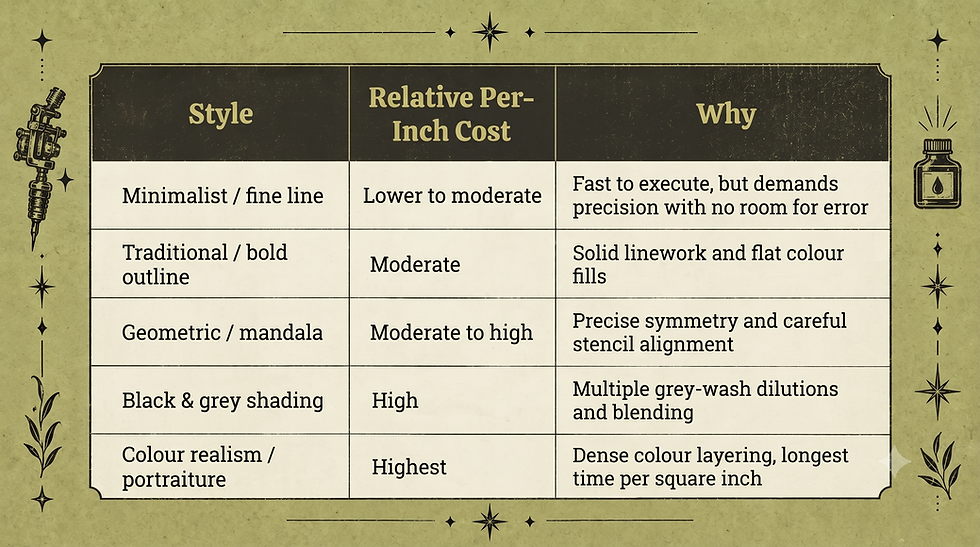
This is a general pattern, not a rule - a highly intricate fine-line piece can easily cost more per inch than a simple bold colour block. Style is one input into the final rate, not the whole story.
How to Estimate Your Tattoo Cost Before Booking
You can build a reasonably accurate estimate before ever stepping into a studio:
Measure the approximate size of your design in inches (height × width).
Calculate the square inches using the area formula above.
Find the studio's rate - most will share this over a call or DM, though some prefer to quote after seeing the design.
Ask about the minimum charge and whether it applies to your size.
Ask whether colour or heavy shading changes the rate, since many studios price these higher.
Confirm whether GST is included in the quoted number or added separately.
Ask about deposit requirements, especially for custom design work.
Ask whether touch-ups are included in the initial price or billed later.
Get the final number confirmed before the appointment, not after the tattoo is done.
This process won't give you an exact figure - only the artist can do that after seeing your design - but it gets you close enough to budget realistically and spot a quote that seems unusually high or low.
Per Square Inch vs. Hourly vs. Session Pricing
None of these models is objectively "better" - each fits a different kind of tattoo. A good studio will recommend the model that suits your specific design rather than forcing everything into one system.
Tattoo Price Calculator
If you'd rather skip manual math, an online calculator can apply the length × width × rate formula for you, along with adjustments for style, colour, and placement. It's a useful way to get a quick ballpark figure before you reach out to a studio - just keep in mind it produces an estimate, not a guaranteed quote, since only an artist reviewing your actual design can account for its specific complexity. You can try our tattoo price calculator to get a starting number for your idea.
Questions to Ask a Tattoo Artist Before Paying
What is your per-square-inch rate, and how do you measure area?
Is there a minimum charge, and does it apply to my design?
Is the first square inch priced differently from additional inches?
Does colour or heavy shading change the rate?
Is custom design work included in this price, or billed separately?
Does the quote include GST, or is it added afterward?
Is a deposit required, and is it credited toward the final cost?
Are touch-ups included, and if so, within what time window?
Will you confirm the final price before we start, not after?
Asking these upfront isn't awkward or unusual - established studios expect and welcome this conversation, since it prevents disputes for both sides.
FAQs
How much does a 1-inch tattoo cost in India?
A 1-square-inch tattoo is usually priced at or near the studio's minimum charge rather than a literal per-inch calculation, commonly landing somewhere between ₹1,500 and ₹3,000 depending on the studio.
How much does a 2×2 inch tattoo cost?
A 2×2 inch design covers 4 square inches. Using a hypothetical rate of ₹800 per inch, that works out to roughly ₹3,200, though actual pricing depends on the studio's rate, minimum charge, and the design's complexity.
How is tattoo price per square inch calculated?
It's calculated by multiplying the design's length by its width to get the total area in square inches, then multiplying that area by the studio's per-inch rate - often with a higher charge for the first inch and a lower rate for the rest.
Is tattoo pricing the same in every Indian city?
No. Rates vary by city largely due to differences in commercial rent and studio overhead, with metro hubs often carrying higher baseline pricing than smaller cities.
Why is the first inch more expensive?
The first square inch typically absorbs the fixed costs of the session - sterile setup, stencil preparation, and initial artist time - that apply regardless of the tattoo's final size.
Do colour tattoos cost more per square inch?
Usually, yes. Colour work requires multiple ink passes and more frequent needle changes than black and grey, which studios often reflect in a higher per-inch rate.
Is there a minimum tattoo price regardless of size?
Yes, almost universally. Most professional studios apply a minimum charge, typically ₹1,500 to ₹3,000, that overrides the per-inch calculation for very small designs.
Do tattoo artists charge per square inch for sleeves?
Rarely. Sleeves and other large-scale work are usually priced hourly or per session instead, since per-inch math becomes impractical at that size and complexity level.
Is per-square-inch pricing better than hourly pricing?
Neither is universally better - per-inch pricing suits smaller, simpler designs, while hourly pricing better reflects the true cost of large or highly detailed work where time varies unpredictably.
Can I calculate my tattoo price online?
Yes, using the basic formula of area × rate, or through a dedicated calculator tool, though the result will always be an estimate rather than a confirmed quote from an artist.


Comments